From the SKI Archive: An Interview With Robert Redford From 1975
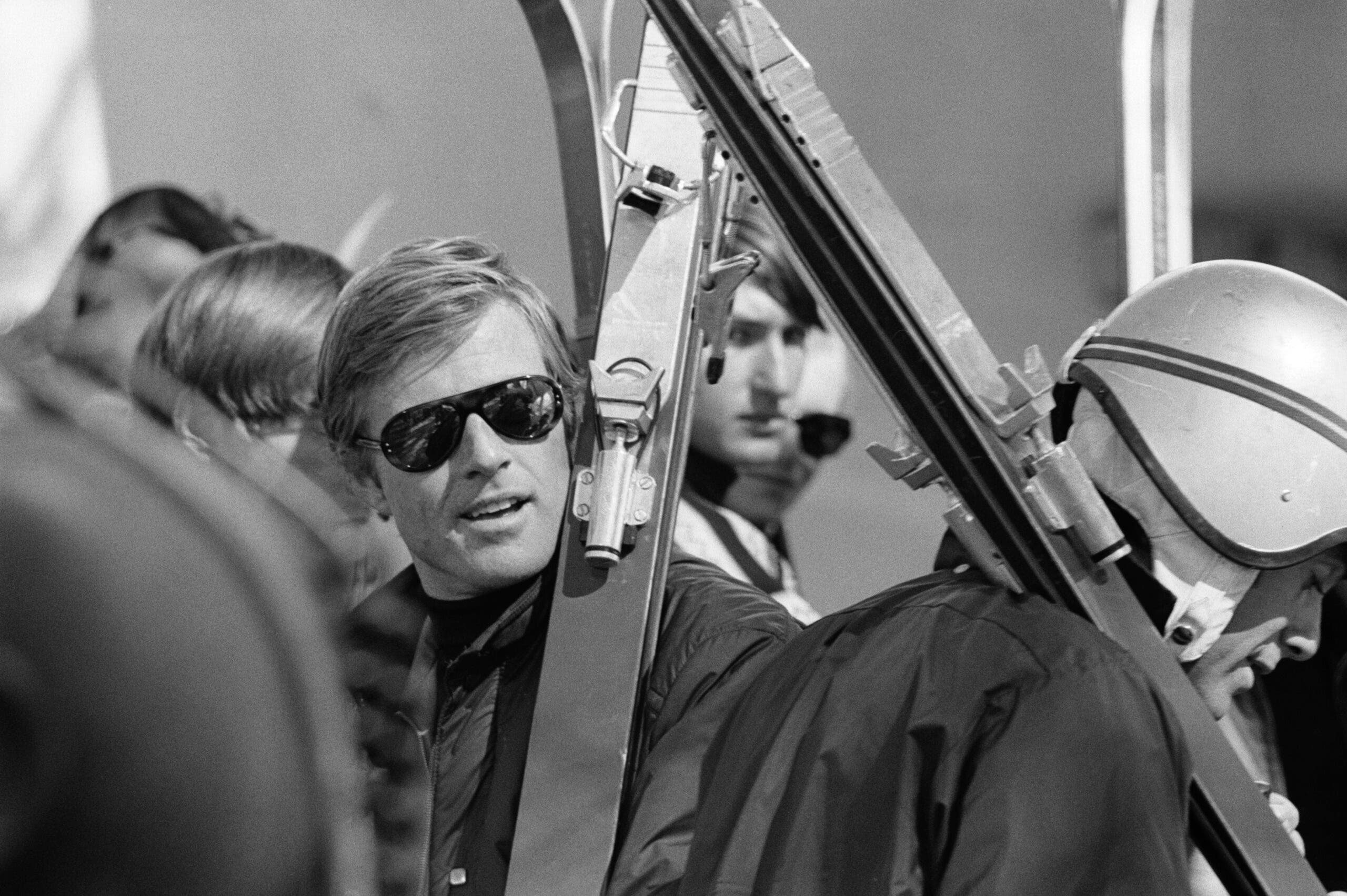
American actor Robert Redford on the set of the skiing drama 'Downhill Racer', Kitzbuhl, Austria, 1969. (Photo by Ernst Haas/Getty Images) (Photo: Ernst Haas / Getty Contributor)
In honor of the late Robert Redford we revisit an interview with him from November 1975.
Updated September 18, 2025 02:29PM
Robert Redford passed away this week at the age of 89. He was a pioneer both in the film and ski industry and the founder of Sundance Resort in Sundance, Utah.
To celebrate a storied career in the ski industry, we revisit an interview from 1975 written by Dick Needham, a longtime editor of SKI, on Mr. Redford, where he shares his take on learning to ski later in life and Colorado traffic. Much has changed, and yet, much remains the same.
Robert Redford. His love for skiing rivals his commitment to acting. An exclusive, what-turns-me-on interview with the Downhill Racer/Sundance Kid.
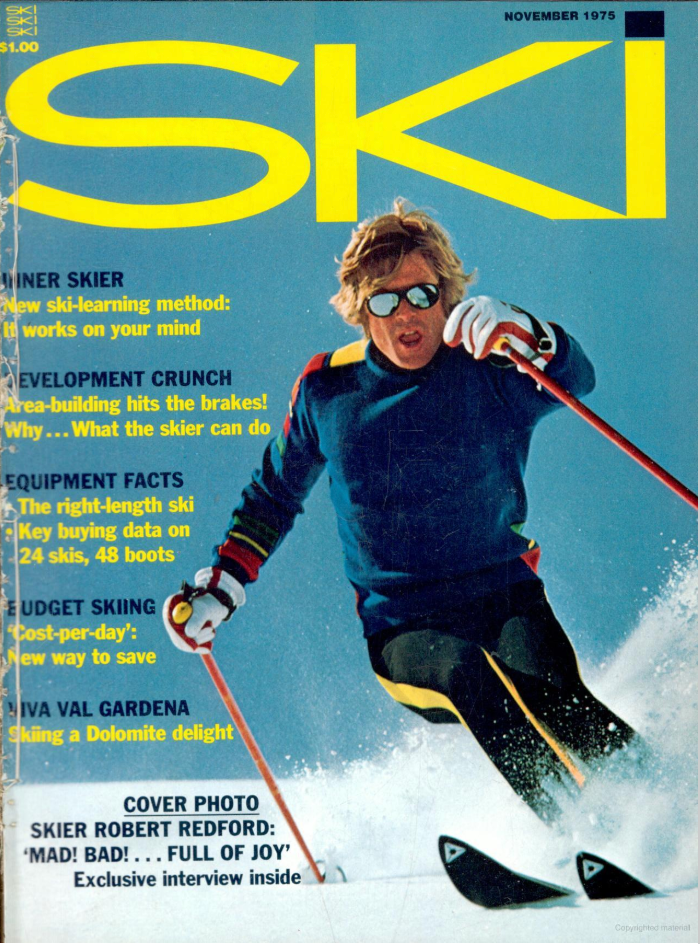
November 1975 cover of SKI Magazine.
(Photo: Courtesy of SKI Magazine/Outside)
By Dick Needham
Robert Redford is not your typical celebrity-as-skier. He doesn’t attend the Bear Valley Pro-Celebrity Race. He isn’t seen among the glam- our throng at the Lange Cup. He doesn’t jet to Gstaad… or St. Moritz.
Fact is, he’s a hardcore skier who’s admittedly damn selfish about the private moments, the losing of self, and the reawakening to beauty and exhilaration that skiing gives him.
And he skis very well. Owner of his own ski area, Sundance (no absentee landlord, Redford has a strong, ever-present hand in the area’s development), he was reared as a skier under Junior Bounous and Jerry Warren (SKI’S pointers demonstrator). What makes Redford different, in one of many respects, is that he learned to ski through racing, putting him miles ahead of most learners in the sport.
Last season, SKI Editor Dick Needham skied with Redford at Sundance. Photographer Scott Nelson was along to shoot the action. After a morning of incomparable sun and powder, they sat down for a break:
Needham: When did you first begin skiing?
Redford: I was a latecomer. I first started skiing seven years ago. I grew up in California, on a beach, and I was more water sports and team sports oriented. In my mid-20s, I lost interest in all that and went into individual sports: tennis, climbing, and, later, skiing. But skiing, for me, has always been it.
Needham: You went to the University of Colorado. Surely you must have thought about taking up skiing while you were there.
Redford: There have been all sorts of hyped-up reports of how I went to Colorado to ski. That wasn’t true. I went to get into the mountains, which I’ve always loved, and to climb. The reason I didn’t ski is crazy, and I guess I’ve always been like this. I didn’t ski because everyone else did, and for some reason, that turned me off the uniformity of everybody putting ski racks on their cars. I loved to go to Aspen, but to drink. We went to the Red Onion—there wasn’t much beyond that in those days.
My interest in skiing really stems from building my house in Utah. I really got turned on to the idea of the naturalness of the sport and the mountain environment. Very early in my life, at about the age of 13, I decided that the mountains were where I really wanted to be. You can hang your hat in a lot of places, but your heart is where your home is, and mine is in the mountains.
Needham: Why did you choose to settle in Utah?
Redford: Colorado, as far as I was concerned, was going down the tube. Natural resources in Colorado were being mined to the point of bumper-to-bumper development, and it seemed that the whole state was going for it. Aspen in those days was a wild, wonderful place to be. Now it’s crowded, infested-it’s great for those who like that sort of thing, but it’s uncomfortable for me. In a sense, that’s what has happened to skiing.
Needham: Could you expand on that?
Redford: There are things that concern me about skiing. I love the naturalness of the sport. There’s such a natural high to skiing. It doesn’t need any hype at all, and I tend to resist the affectations that I see in skiing. I remember watching a group of young guys at Snowbird last season. They were bombing down the hill, really trucking it. I don’t mean hooting and hollering in an affected way, naturally.
On the other hand, other aspects of the sport have become a bit mannered. And that doesn’t do it for me at all. It’s as though Madison Avenue had grabbed the idea and blew it right out into oblivion. There’s a whole shopping mall kind of mentality that’s taken over skiing.
You’re besieged. It’s almost like 1984. There’s a curious kind of irony there. You’re besieged with ski films wherever you go. I remember being in Park City one day, waiting for the gondola; they had put up a screen and were running hot dog films while we were waiting in line. They wouldn’t let you alone. Thank God they took it down; they had the good sense to say, “Hey, this is overdoing it.”
It all has to do with the way the sport is marketed. There’s a healthy tide turning in America, the resistance to being oversold. Skiers just aren’t buying this synthetic, hard-sell approach to something that should be natural.
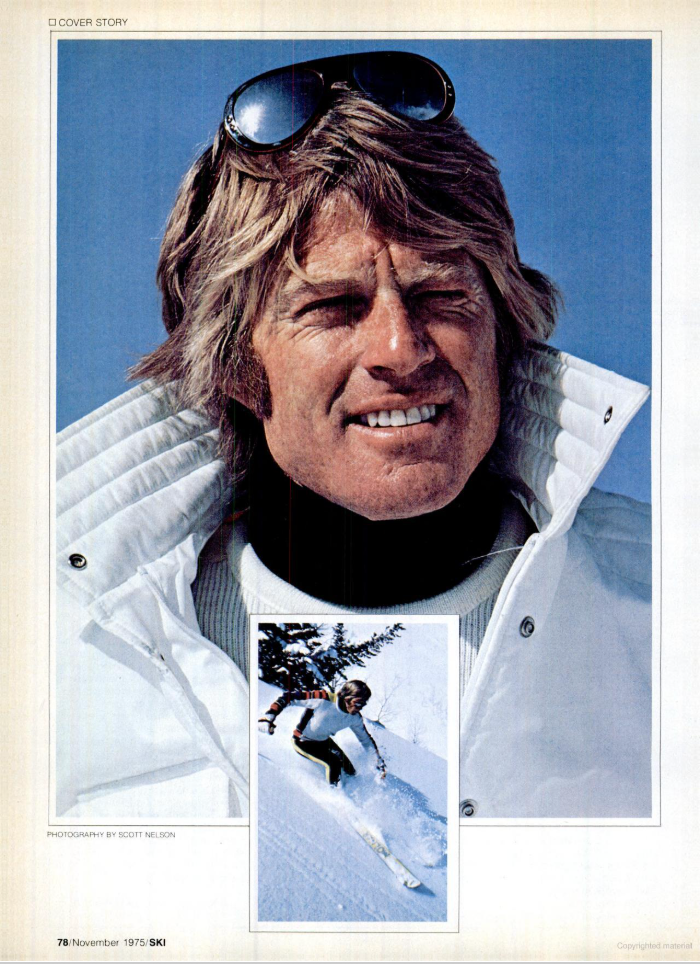
Robert Redford for SKI Magazine
(Photo: Courtesy of SKI Magazine / Outside)
Needham: It’s an interesting point. Who, or what, do you feel has been responsible for this oversell?
Redford: For one, I never did believe any of those number experts who give you the computerized figures of 6 million skiers in the United States. That’s a lot of crap. It’s that kind of attitude, the business-school-grad- computer-index-card game, that I think is threatening skiing.
To be honest with you, I have to stick with the older guys, the McCoys, Friedl Pfeifers, Tommy Corcorans, and the skiers from the Tenth Mountain Division who really did something for the sport. They’re the responsible ones because they know their mountain. They’ve been up there. They’ve climbed it at night. They’ve been through it in storms. They’ve trudged it on foot, and they know every square inch of it. They’re not some hotshot business-school grad who’s never seen a pair of skis and comes out and says, “I don’t have to see the mountain, just give me the count for consumption of more energy. It’s absolutely crazy!
You see, I don’t believe there is an energy crisis. There’s a high percentage of energy that can come from natural sources, but we just don’t want to spend the money because there’s no big corporation that owns them. If Standard Oil owned the sun, we would have had solar energy a long time ago. The government isn’t going to develop it. They’re dragging their feet. So we’re going to do it ourselves, independently.
Needham: You have other commitments, namely to your film career. How are you able to devote time to skiing, let alone overseeing the development of a ski area?
Redford: When I ski, it’s like cramming for an exam. I don’t have much time, so I have to get loose fast. But it’s tough. I’m beginning to pay the piper for some of those wilder shots I took when I was younger.
For me, skiing is magnetic-it’s very sensual. It’s the one thing I can do that gives me complete freedom of mind. It’s the only area where I’m by myself, where I can just get away and set myself free, and I’m very selfish about it.
To any skier, I’d say, “Look, I believe in skiing because I know what it does for you. Don’t give me all this hyped-up glamour pap. If you feel like yelling, yell. But don’t feel you have to yell because all the hotdoggers are doing it. Just do what you feel like doing… and it will all come out. It’s such a great high.
Needham: How would you rate yourself as a skier?
Redford: Bad! Mad! Bad! All hungry and full of joy!
Needham: Have you ever encountered problems in your ski technique that have been hard to overcome?
Redford: Yes. I have one basic flaw in my skiing. I water-skied quite a bit as a kid. And in water skiing, you have to lean back. The further back you lean, the more action you get. So the natural tendency for me was to always sit back on my skis. I find I have to mentally get myself ahead, get forward on my skis. This creates problems for me because I have a bad back; I injured it when I was young.
But I like to ski fast, and I know that by getting my weight back at the right time, I can gain some speed. I really learned my skiing from racing rather than recreational technique. I was turned on by racing.
I love skiing so much that I don’t care if I screw up a run, as long as I’m moving, as long as I’m going fast enough to feel the exhilaration. I don’t even stop for lunch. I don’t stop. Eat, you can, but stop, and you lose your rhythm.
Needham: What equipment do you use?
Redford: I ski several brands of skis. It seems everybody’s getting into the act. To be honest with you, you have to be pretty damn good to be able to differentiate between brands of skis these days. They’re all good, and so are today’s boots and bindings.
I prefer a longer ski because I like to ski fast. As a result, I’ve found it tough adjusting to a shorter length. Right now, I’m on a 195, and I prefer a 205, but with the bumps, I just can’t take it.
Needham: Let’s talk about films for a minute. What did you have in mind when you made “Downhill Racer”?
Redford: “Downhill Racer” was a very personal film for me. It had a lot of implied thoughts that didn’t have anything to do with skiing. It had to do with amateur athletics in the United
States, the kind of athletes we seem to spawn in this country.
It’s a mistake to say that “Downhill Racer” was a ski film. I chose skiing as the supportive element because that was the sport that turned me on, and I thought it had the perfect blend, visually, of poetry and danger.

American actor Robert Redford as David Chappellet in the film “Downhill Racer,” 1969.
(Photo: Photo by Silver Screen Collection/Getty Images)
Needham: Is skiing a saleable commodity in Hollywood?
Redford: Not really. “Downhill Racer” wasn’t that successful in terms of broad audience appeal to a lot of people; there just wasn’t enough of a story.
Without a plot, you don’t have a film. You can make a film about a man who makes shower curtains, and if it’s a good story, if it has dramatic drive, if it says something strong or entertains, then shower-curtain films will be in. If you can’t carry a story, it’s not going to work.
Needham: What do you think about the ski films being made today? Do you feel they’re doing a job?
Redford: There’s some beautiful photography in the ski films-no doubt about it. And there are some genuinely talented photographers out there. “Downhill Racer”, in its own way, helped. When Joe Jay Jalbert ran the downhill course, it was the first time he had ever held a camera in his hands. He’s since moved on to some fine cinematography.
But I have to say that you reach a saturation point with the straight ski film. You finally get to the point where you either have to graduate into feature films or make some kind of statement, tell a story, create drama. Otherwise, you only tend to recycle your own work and your own talent. Ski films are not unlike fashion; there’s a burst of new, exciting, innovative stuff, and then they hit a plateau where nothing seems to happen. I’ve kind of had it with the flips, back flips, sun shots, and all the forced clowning and yelling. It’s as if they’re saying, “I know what turns you on” and “Let me show you what’s steep.”
Needham: Though you say the film was a personal statement, “Downhill Racer” touched in part on the then-current problems of the U.S. Ski Team. How do you feel about the Ski Team today?
Redford: I think we’ve blown it by not subsidizing our racers and by not attracting the real poverty elements of our society. It’s time to make ski racing a broad-scope attraction.
I think we would have had a better team and could have had a better team today, had we been able to attract some hungry street fighters. American boxers, for example, have always been tops because the modern era of boxing was created by street fighters who came out of the ghetto. The only way these kids could get out was to fight their way out competitively. Yes, fine, boxing is a brutal sport, but there was something undeniably attractive about it because it gave the kid a chance. I believe in that. I think skiing needs street fighters.
Needham: You’re a regular contributor to the U.S. Demonstration Team of professional ski instructors. Why?
Redford: Now that’s something else again. The group that went to Interski in Czechoslovakia went to show the beauty of skiing. They demonstrated the American ski technique, as taught by Americans. That, to me, is better ambassadorship than sending a youngster over to race. Their visit was really a hit-they were the only team on Czech TV. They have a great spirit.
***
Similar Reads


Commenti
Posta un commento