Home is where the heat is

Jakob Ingebrigtsen's magnificent obsession
but it’s one I’ve been feeding my whole life’
At home in Norway, the iron man of athletics says his career feels like ‘99% losses’ but plans to retire as the greatest distance runner in history
‘For me, this is not only a job,
I’ve had this life for as long as I can remember’
‘I am very much an introvert in general,
but am an extrovert in an environment where I feel safe’
24 Jan 2026 - THE GUARDIAN / Sport
Sean Ingle
On a bone-cold new year’s morning, the world’s most compelling athlete is sweating so much that tiny puddles are starting to ooze across his treadmill.
MARIE VON KROGH/ THE GUARDIAN
For 40 minutes Jakob Ingebrigtsen makes 6min 40sec mile pace look like a Sunday stroll, breezily chatting away even as the heatbox in his home gym pushes the temperature inside to more than 32.4C (90F). Only when I ask the double Olympic champion what his super-strength is does he pause to take a proper breath. “In Norwegian we have a word for it,” he eventually replies. “Ingen kompromiss. No compromise.”
For the final 20 minutes of his run, Ingebrigtsen starts to push it. The music goes on. The treadmill is cranked up to 5:13 minute-per-mile pace. His pulse steadily climbs from 130 to 172 beats per minute. Sweat starts to flow. And, as he finishes, it seems apposite that Black Sabbath are pounding away on the stereo. “Running as fast as they can, Iron Man lives again!”
Because after a year from hell in 2025, during which the Norwegian tore an achilles and was involved in a highly public court case against his father and former coach, Gjert, track and field’s iron man is ready to run fast again.
Ingebrigtsen is often mischaracterised as arrogant, when really he is just forthright. He is also unusually welcoming, inviting us into his home in Sandnes, near Stavanger in south-west Norway, where we spend the best part of a day with him, his wife, Elisabeth, and his two golden retrievers, Maximus and Jupiter.
At one point Elisabeth pops down to the local bakery to buy us lunch, while later Jakob drives me to his farm in one of his sports cars. There is no PR person acting as a buffer either. All of this, to put it mildly, is highly unusual.
And Ingebrigtsen’s lack of filter, which can rub his rivals up the wrong way, also means he is blunt and honest about his own scar tissue.
Early in our conversation, I ask Ingebrigtsen whether the wins or the losses linger more in his head, and I am taken aback by the reply. “I want to say that I almost don’t remember the wins,” he replies. “Almost.” But you remember the defeats? A nod. “Right now I feel like it’s 99% losses to wins.”
Shortly afterwards a noise distracts Ingebrigtsen and he goes off to investigate. When he comes back I start to ask: “Do you think you’re slightly …” when he interjects. “Autistic, yes?” he says, laughing. “With this obsession, this dedication, this level of intensity, of course there has to be something …
“For me, this is not only a job. I’ve had this life for as long as I can remember. So in reality it’s not only: ‘I lost, let’s go on.’ It’s bigger than that for me, because it’s such a big part of my life. Everything that I do, and I’ve always done as long as I can remember, has always been performance-oriented.”
Can you blame Ingebrigtsen for such an approach? His upbringing, which was part science experiment, part Truman Show, made him that way almost from the crib.
He started training professionally from the age of four or five, and by 12 he was running upwards of 100km a week. At 16
he became the youngest person to break the four-minute mile. At 17 he was the European 1500m and 5,000m champion. And by 20 he was the Olympic 1500m champion. Much of this was captured on Team Ingebrigtsen, a docu-series featuring Gjert and Jakob’s brothers, Henrik and Filip, that became Norway’s most successful ever TV show.
Since then his CV has expanded to include two Olympic gold medals, four world titles, indoor and out, five world records, and 22 European titles over track and cross-country. But it is the ones that got away – such as the 1500m in the Olympic Games in Paris – that continue to linger and sting.
In that final he went out in a suicidal 54 seconds for the first lap and paid the price as he ran out of gas in the final 100m and finished fourth. Regrets? He certainly has a few, even 18 months on.
“Considering how good shape I was in at that Olympics, I think nine out of 10 times I would have won the 1500m,” he says. “And this was the 10th. If I had just done anything differently, I think I would’ve had a better outcome.”
Still, at least he had redemption by destroying the field to win 5,000m gold a few days later, I tell him. He looks at me like I am mad. “No, no,” he interjects. “It definitely wasn’t a redemption, no. There’s really nothing that can outweigh the disappointment of the 1500m.”
Has winning become an obsession, I ask. “Yes, definitely. It’s an obsession. But I’ve been able to feed that obsession my whole life.”
Given Ingebrigtsen’s uncompromising attitude, the fact he showed up to compete at September’s world championships in Tokyo spoke volumes. He knew he was not fit, having just recovered from his achilles injury. And, he says, there were no stipulations in his Nike contract that meant he would lose money if he didn’t turn up. He just felt it was the right thing to do.
“That is just how I am, and how my life has been,” he says. “I’m always competing, even if the odds are against me. Even when I was 12 years old and competing against seniors at national level, I still wanted to win, but I knew it was unrealistic.”
Ingebrigtsen, who was knocked out of the heats in the 1500m and could finish only 10th in the 5,000m, knew what was coming. But still he pressed on. “I’m not a dreamer,” he says. “I am analytic and realistic. But there’s always a chance of anything. And that chance is taken away if you don’t show up.”
So how is his body now, four months on from his last race? “The achilles is very good,” Ingebrigtsen says. “But because of the last couple of years, I am a little bit more cautious. So I am prioritising my fitness towards the outdoor season. I will probably start at the Bislett Games in June. But my goals are to get double gold at the European championships, a Diamond League final victory, and to make one good world record attempt in the 1500m, the mile and also the 5,000m.”
The 25-year-old will also get to renew his testy relationship with Josh Kerr, who beat him to 2023 world championships gold. Not that the Norwegian sees the Briton as a rival.
“I have never considered anyone to be my rival,” he says. “Because I’m always competing against myself. And I usually don’t look at the start list. Because it’s always going to be people that can threaten or can compromise my race, whatever.”
But does it annoy him when some people suggest he doesn’t have a finishing kick in the 1500m? He takes a deep breath. “No, I think it’s just ignorance,” he says, before making an analogy worthy of Éric Cantona. “If you look out of the window, it’s white. You can see it snowing. But if you dive deeper, under the snow it’s grass. That’s how it is with performance. People draw conclusions on the factors that are actually visible.”
At the 2023 World Athletics Championships he had a virus, he points out. While in Paris, he went off too fast and paid the price. The whole point of a race, he stresses, is to use your best strengths to win.
“I just think it’s funny,” he says. “My worst fear is to start sprinting when people are already finished. I can’t imagine how stupid you must feel as an athlete if you’re actually starting to sprint when the race is over. You have to play your cards right, so that you can time your effort so that you are the first to the finish.”
He points to the French athlete Jimmy Gressier, who won the world 10,000m title in Tokyo last year. “He is a good runner. But because he’s a strength-endurance runner, he’s not very fast. Yet the whole point, especially in a championships, is about who can reach 400m to go with the most energy left. And in the 10k in Tokyo that was Jimmy.
“You can argue that there was someone in that field who was faster than Jimmy. But they were struggling, because they didn’t have the same amount of energy left. And that’s the whole point.”
Ingebrigtsen is just as outspoken when it comes to the state of his sport. He praises the Athletics Integrity Unit, calling it a “very good organisation”, but he wants far more funding made available to catch dopers. And, as someone who watches Formula One, he also wonders why track and field cannot do more to tap into its potential given he believes that it is far more exciting than F1.
“The paradox is indescribable, because how can a sport that is so boring in reality be so entertaining for so many people?” he asks, “99.9% of people watching F1 don’t even know what the cars are. They probably don’t even know that there’s a battery inside the engines as well.”
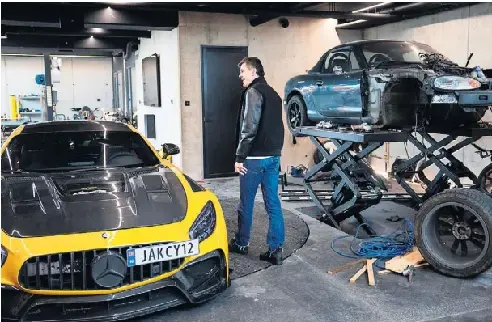
Ingebrigtsen certainly knows his way around a car. In his garage he has all sorts of vehicles, from sports cars to vintage motors. How many does he have? “That is a good question,” he replies. “I think if you start counting, that’s when you have an issue. So that’s why I don’t count.”
But Ingebrigtsen doesn’t just buy cars. He loves working on them. Every Wednesday he and his friends, some of whom are mechanics, get together. “We try to have a little bit of fun with it,” he says. “I’m 100% a petrolhead. And you see a lot of new people from a completely different side of society.”
Is it also true that he spent $300,000 (£220,000) on Pokémon cards? “It’s been rounded up,” he says. “But I think I have a collecting gene. I tend to collect a lot of different things, which is not always good.”
At this point Elisabeth, who is working on her laptop on the sofa, starts to smile. “No, it is not!”
After our interview, Ingebrigtsen drives us to the farm about 10 minutes from his home that he reportedly bought for 12m Norwegian kroner (£900,000). For now it grows potatoes but, one day, Ingebrigtsen says he might rear Wagyu cows on his land.
“There’s actually a guy close by who has done that,” he says. “But what’s so exciting about it is that you can grow whatever. You can have grapes, apple cider, vegetables, or animals. And Elisabeth, she’s grown up on a small farm with horses.”
His mood is certainly lighter than this time last year, when he faced a court case against his father and former coach. It ended with Gjert being given a 15-day suspended sentence after being found guilty of hitting Jakob’s younger sister in the face with a wet towel. However, Gjert was acquitted of other charges, including those relating to physical and verbal abuse against Jakob, after the judge found there was reasonable doubt.
Understandably, Ingebrigtsen doesn’t want to trawl over painful memories. Instead he is far happier talking about another family member, his 18-month-old daughter, Filippa, marvelling at how quickly she is learning and growing.
Has parenthood changed him? “No,” he says. “I think I’ve always had the capability of being a caring person, but not when I don’t want to be. As an athlete, it’s completely the opposite. I don’t allow myself to have those feelings and thoughts.”
He accepts he is a loner, except when it comes to a small band of friends. “I am very much an introvert in general, but I am also very much an extrovert in an environment where I feel safe,” he says.
Elisabeth concurs. “You do care about people, just a very small group of people,” she says. “That’s the difference.”
But one thing is clear over the course of an interview that goes deep into a second hour: despite last year’s bump in the road, Ingebrigtsen’s ambitions haven’t changed. He wants to retire as the greatest distance runner in history. He says he is back running about 175-180km a week (108-111 miles), far higher than most 1500m specialists, as he gears up for the summer.
Does he ever take days off ? “No, because if you have a day off, you lose 20-25km of running,” he replies. Of course he trained on Christmas Day. Twice, in fact.
“I know I can beat most of the world records from 1500m to the marathon,” he says. “But it’s not easy. You really have to prioritise it, and you also have to find the right place and right time.
“My 2025 season was a great setback in terms of my career. But I’m still highly motivated. Let’s say I can have 10 more years from now. If I can do that, then I think I have a good chance of reaching my ultimate goal.”
And with that it is back to the treadmill for a second session of the day. Another hour of sweating and suffering. Another chance to fuel his burning obsession again.


Commenti
Posta un commento