Post

Visualizzazione dei post con l'etichetta John Carlos

Tommie, John e il ’68 Quei pugni contro il cielo per scuotere tutta la terra

Immagine
FOTO LAPRESSE - Protagonisti. Il podio del ’68  con  Tommie Smith, John Carlos e Peter Norman RIVOLUZIONARI - Il podio più sovversivo delle Olimpiadi Contro le discriminazioni A Città del Messico anche l’australiano Norman si unì alla protesta di Smith e Carlos 10 Jul 2025 Il Fatto Quotidiano Stefano Boldrini Un pugno, guantato di nero, alzato verso il cielo di Città del Messico per sensibilizzare il mondo nella lotta contro le discriminazioni, è il gesto più rivoluzionario del mondo dello sport, superiore persino al rifiuto di Muhammad Ali di arruolarsi per andare in guerra in Vietnam. Il 17 ottobre 1968, lo sprinter statunitense "Tommie Jet" Smith, medaglia d’oro ventiquattro ore prima nella finale dei 200 metri di atletica leggera e nuovo primatista mondiale con lo straordinario tempo di 19’’83 – solo undici anni dopo Pietro Paolo Mennea riuscirà a superarlo –, aveva appena 24 anni e si consegnò alla storia. Smith era la cima del podio più sovversivo di sempre: lui, l’aust...

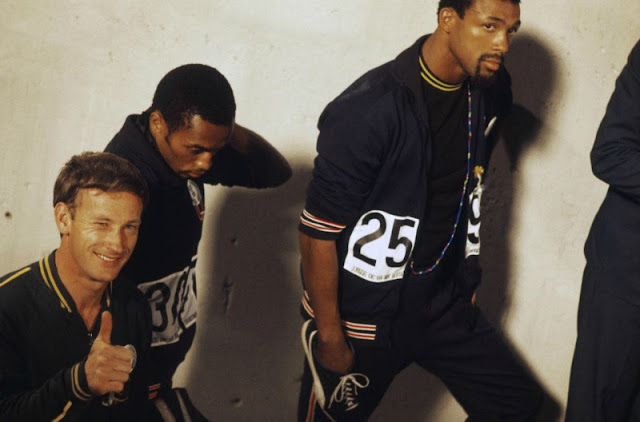
Amid Gold Medals, Raised Black Fists

Immagine
A stubborn protest jars the Games JEREMY LARNER, DAVID WOLF LIFE magazine - 1968, 1st November   When you stop to think about that, the small group of black track stars who organized the "Olympic Project for Human Rights" have got quite a lote done in less than a year. Led by Harry Edwards, a professor at San Jose State, they helped keep South Africa out of the Games. They humbled the prestigious New York Athletic Club by publicizing its discriminatory membership policies and persuading an impressive number of top athletes to bypass the club's famed annual meet. And they've ignited a lasting racial consciousness among the previously uncommitted black American college athletes. The most prominent spokesmen of the original group were Tommie Smith, Lee Evans and John Carlos., all of San Jose State. They are not separatists. They do not believe in violence. They are dedicated to ending what they see as exploitation of black athletes and, in the process, gaining dignity a...

The White Man in That Iconic Olympics Photo

Immagine
https://onbeing.org/blog/the-white-man-in-that-iconic-olympics-photo/ Riccardo Gazzaniga Published August 18, 2016 Sometimes photographs deceive. Take this one, for example. It represents John Carlos and Tommie Smith’s rebellious gesture the day they won medals for the 200 meters at the 1968 Summer Olympics in Mexico City, and it certainly deceived me for a long time. I always saw the photo as a powerful image of two barefoot black men, with their heads bowed, their black-gloved fists in the air while the U.S. national anthem, “The Star-Spangled Banner,” played. It was a strong symbolic gesture — taking a stand for African-American civil rights in a year of tragedies that included the death of Martin Luther King and Bobby Kennedy. It’s a historic photo of two men of color. For this reason I never really paid attention to the other man, white, like me, motionless on the second step of the medal podium. I considered him a random presence, an extra in Carlos and Smith’s moment, or a kind...

Raising my fist at the Olympics cost me friends and my marriage — but I’d do it again

Immagine
https://www.vox.com/2016/7/13/12118332/john-carlos-olympics by John Carlos Jul 13, 2016, 2:00 PM GMT+2 After I retired from running, I was a counselor for 20 years at several schools in Southern California. At first, no one knew I was an Olympian who'd made international news for raising my fist on the medals podium in 1968 — not the district, and definitely not the students. One morning I spotted four kids sneaking out of the school building, trying to play hooky. I ran after them, and I was right on their butts. Then they turned a corner and disappeared. At first I didn't know where they'd gone. And then, from the bushes, I heard one of the kids saying to the others: Peter Norman, Tommie Smith, and John Carlos  on the medals podium  at the 1968  Olympics (Universal History Archive/Getty Images) "Man, who the hell is that old man? He can run." When I told them to come on out, they asked me, "Who are you?" I said, "Maybe if you was in school, you m...

A COURAGEOUS STAND

Immagine
https://vault.si.com/vault/1991/08/05/the-1968-olympics-a-courageous-stand-first-of-a-two-part-series-in-68-olympians-tommie-smith-and-john-carlos-raised-their-fists-for-racial-justice IN '68, OLYMPIANS TOMMIE SMITH AND JOHN CARLOS RAISED THEIR FISTS FOR RACIAL JUSTICE KENNY MOORE AUGUST 05, 1991 TABLE OF CONTENTS ORIGINAL LAYOUT On Oct. 16, 1968, minutes after the Olympic 200-meter dash in Mexico City, gold medalist Tommie Smith and bronze medalist John Carlos stood in stocking feet on the victory platform, bowed their heads during the U.S. national anthem and shot black-gloved fists to the sky. They meant their unshod feet to represent black poverty, Smith's black scarf and Carlos's beads to signify black lynchings, their fists to mean black unity and power. Any resemblance to Lady Liberty lifting her torch was ironic, for Smith and Carlos were taking U.S. society to task for having failed to extend liberty and justice to all. The tableau was riveting and grim. Most of th...