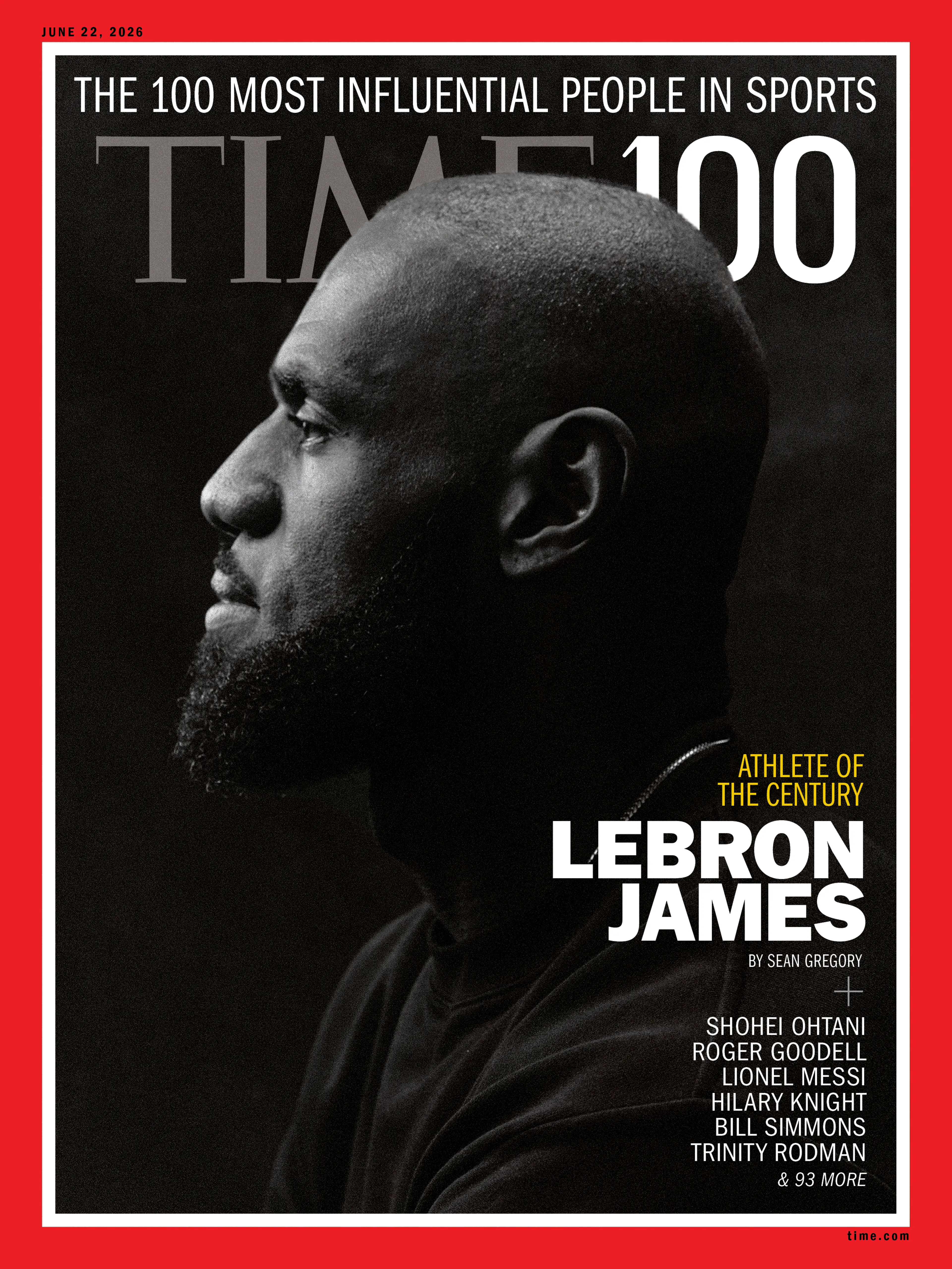
How LeBron James Redefined the Modern Athlete
Mark Clennon for TIME
TIME
Jun 09, 2026
Senior Correspondent
Mark Clennon for TIME
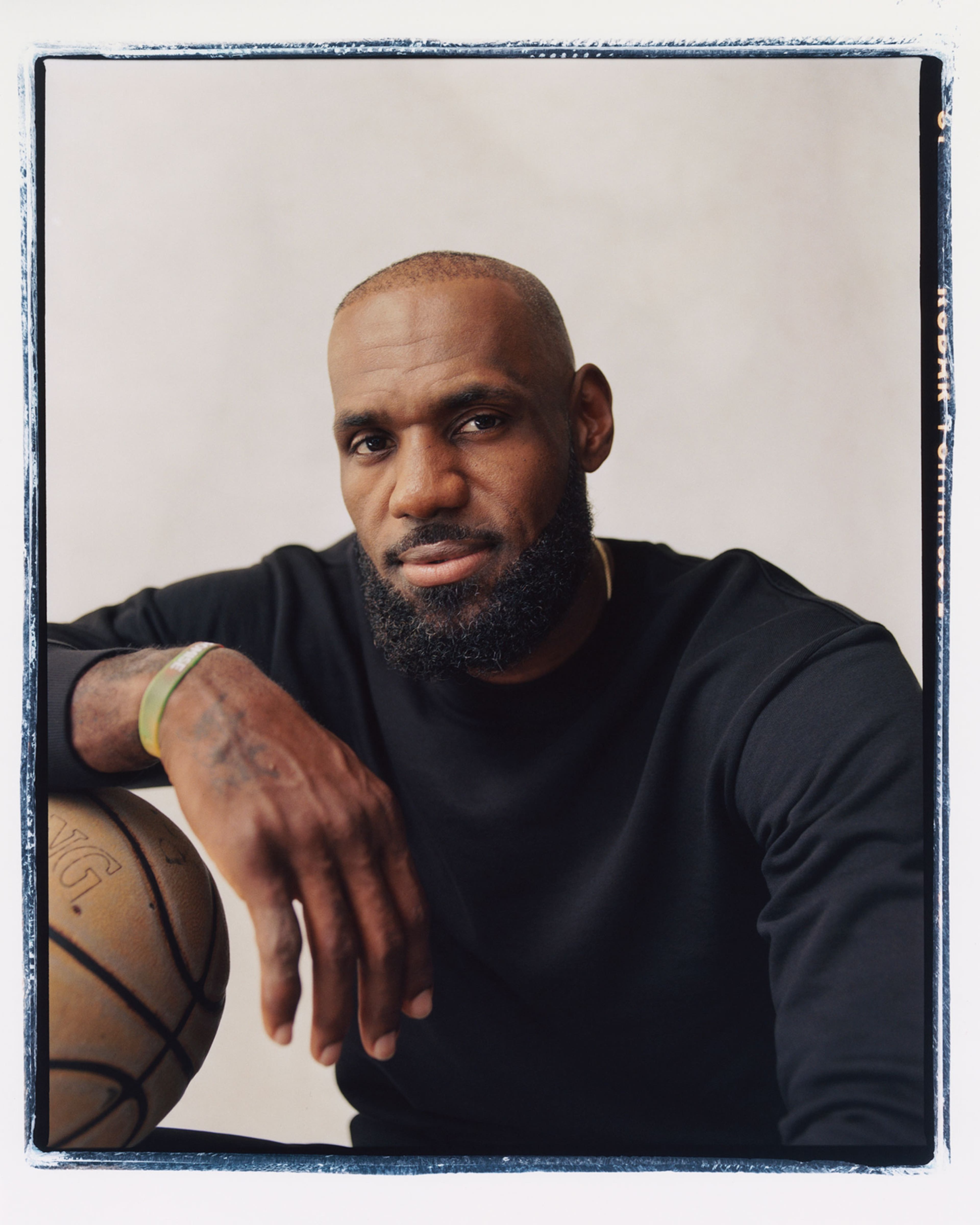
A purple smock adorned with smiley faces cloaks LeBron James’ body around 7:30 a.m. one mid-April morning, as he’s groomed for a magazine cover shoot at the Los Angeles Lakers practice facility in El Segundo, Calif. Typically, this would be awful timing for a reflective talk with one of the world’s most famous people. James hasn’t been sleeping well. His speech is groggy. A first-round playoff series with the Houston Rockets opens in three days. He has practice soon.
But throughout a rare exclusive interview, James is utterly locked in. In fact, I can’t recall an athlete more present for one of these sit-downs. As some half-dozen people hover around him, James maintains his focus, answering each question that comes at him, including the most pressing one: How long does he want to keep playing?
“It’s up to the mind,” says James, 41. “Where the mind goes, the body will lay. When I’m not in love with getting to the arenas on game days five hours before to start my preparation, if I’m out of love with getting to practice 2½ hours beforehand, then I know I’ll be done. Because then I'm going to start cheating the game.”
Right now, James remains very much enamored. “Hell yeah,” he says. “I’m sitting here talking to you. I don’t have a voice, I’ve got practice in an hour. You think I’m not having fun still? I could have my ass at home, with a hot pack on my throat, having a f-cking hot toddy and some scrambled eggs.”
Instead, James continues to sustain his excellence, to a degree never before seen in major pro sports. Already the leading scorer in NBA history, a middle-aged James once again produced at an All-Star level in 2025–26, his 23rd NBA season. When Lakers stars Luka Doncic and Austin Reaves missed postseason games with injuries, James showed he can still play head honcho, propelling his team past a talented Rockets squad, before the Oklahoma City Thunder sent his undermanned team home.
TIME100 Sports | LeBron James’ GOATS
Having entered the NBA as the most-hyped high school athlete in history, James wrote the blueprint for exceeding the types of expectations that felled so many before him. His superior skill level and genius hoops IQ as well as the great care he’s given his physique allowed him to run roughshod over NBA record books: 22 straight All-Star selections, all-time leading playoff scorer, most first-team All-NBA selections, etc. “He’s had the greatest career in NBA history,” says two-time NBA MVP Steve Nash, who co-hosts the Mind the Game podcast with James. “You combine his peak and his longevity, and there’s nobody that comes close.”
Add in his off-court accomplishments, and James may be the most influential athlete of the past half-century. In the decades before his arrival, superstar athletes mostly stayed in their lane. James ushered in the era of player empowerment, showing that you can start companies, mix it up in politics, and elevate the people around you—all while playing like the GOAT of your game. “I don’t think it’s a stretch at all to say LeBron is one of the most important athletes in American history, and one of the most important Americans of the 21st century,” says Todd Boyd, professor of race and popular culture at the University of Southern California.
In the face of public doubt, he entrusted his business affairs to friends, used leverage to make his own decisions on where to play, and engaged with the broader world around him. He invested his equity in global sports brands, technology, and his hometown of Akron, Ohio, while enjoying healthy returns. “The guy is smart,” legendary investor Warren Buffett, who’s met with James several times over the years, tells TIME. “He’s a smart guy on the court, he’s a smart guy off the court.”
Mark Clennon for TIME
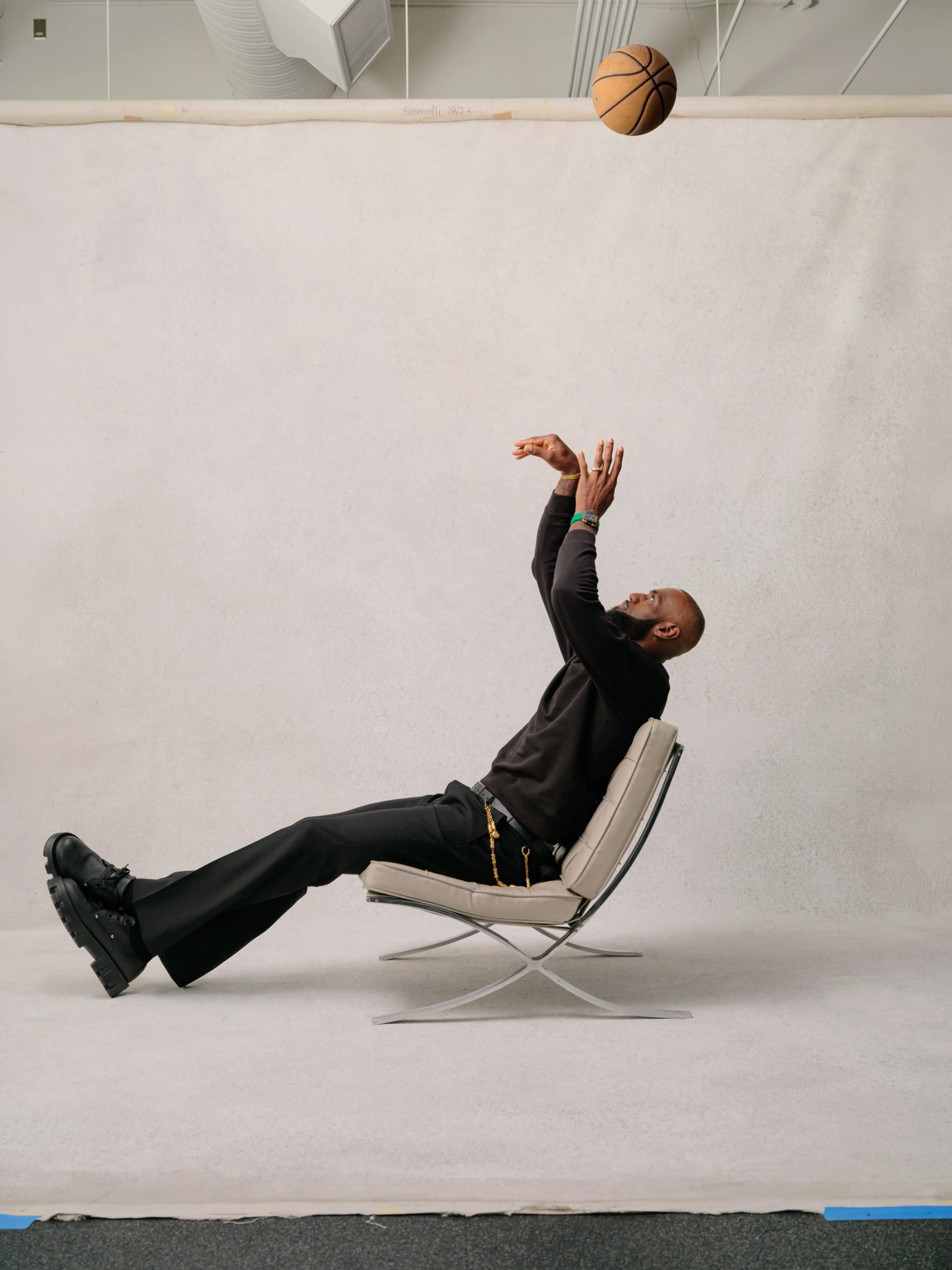
And while he’s been outspoken about politics and social justice, drawing criticism from the right, his decades-long career has been basically scandal-free. His big controversy this year? Dissing the hotel he’s stayed at while playing in Memphis. “Everything I say and do is overblown,” says James during his haircut. “I don’t have a problem with Memphis people. People need to know that. I have a problem with that hotel, and I don’t like going there.”
GOAT debates pit James against Michael Jordan, whose come-fly-with-me style, six titles in the 1990s, and rocket fueling of global sports marketing, through Air Jordans and other endorsements, created a lasting legend. While the relative merits of their basketball bona fides can be—and most definitely have been—argued ad nauseam, James spoke up on uncomfortable topics. Jordan, on the other hand, said he was reluctant to do so, because Republicans buy sneakers too.
When I invite James to agree that he’s a more influential athlete than Jordan, he just laughs. “You ask somebody that grew up in the Jordan era, they’re gonna say Jordan,” says James. “You ask somebody who grew up in the LeBron era”—he pauses for a beat—“they’re still gonna say Jordan.” Which he understands. “Listen, to each his own,” he says. “I can tell you this. I never step my feet in another man’s shoes, saying, ‘OK, well, sh-t, I got to do better than him.’ My journey is my journey. I do what I do. I know what I’ve brought to the table. From a basketball standpoint, an inspiring standpoint, an influential standpoint, I know I can walk in any room.”
Growing up in a tough area of Akron, James spent hours in his own head. “I had so much time to explore and imagine and want to be more than a little Black kid that stays in the house and feels sheltered,” he says. He rarely saw Akron marked on maps. “When you feel like you are being slighted, that’s a motivating factor,” he says. “I felt slighted that I was in a single-parent household. I felt slighted because I didn’t have any siblings. So I’ve always felt a certain chip on my shoulder.”
James, who skipped college to turn pro, was determined to share his success with his inner circle. The Cleveland Cavaliers won the 2003 draft lottery and took their native son with the top pick. He won Rookie of the Year and after his second season fired his agent and formed a company called LRMR, a first-name acronym for LeBron James and friends Rich Paul, Maverick Carter, and Randy Mims, to handle his business. Critics derided the move, given their lack of traditional management experience. In 2016 Phil Jackson sparked controversy when he referred to them as James’ “posse.” (Jackson later said his "word choice could be something I could regret.")
“If I would have listened to the narrative of the outside world, I would have been doomed,” says James. “Because everybody said it was a bad idea. Why am I hiring people with no education? Why am I hiring people that haven’t been in the business? Why am I hiring my childhood friends? Everybody, when it comes to things that have never been done before, they want you to go to the sound of the beat that was from yesterday, or the beat that was from 10 years ago. My mom never raised me to be that way.”
“You know how LeBron James changed the game?” says Paul, from his office overlooking Beverly Hills, Calif., where he runs the Klutch Sports Group, an agency representing James, A’ja Wilson, Jalen Hurts, Myles Garrett, and some 700 other athletes. “He changed the game because he was the athlete that was willing to tell that prominent person that was in position with a business card from a high-level corporate institution to go f-ck themselves.”
James played seven seasons with Cleveland, winning two NBA MVPs, leading the Cavs to two seasons with 60-plus wins, and reaching the NBA Finals. Still, he fell short of a title, and in 2010 seized an opportunity to join forces with Dwyane Wade and Chris Bosh. On the now infamous ESPN program The Decision, James told the world he would “take my talents to South Beach.” A portion of the ad revenue, $2.5 million, was donated to the Boys & Girls Clubs of America.
Mark Clennon for TIME
Still, critics hammered the televised event as egotistical and self-serving. In Cleveland, fans burned his jersey. “It was the most ridiculous thing,” says James. “I thought it was overblown then. I know it’s ridiculously overblown now.” The source of the venom was twofold. First, by reporting the news himself and creating a superteam in Florida, he was wresting his story from entrenched power structures: the media and NBA suits. Second, superstars were supposed to deliver titles for the teams that drafted them, like Jordan had done in Chicago, Larry Bird in Boston, and Magic Johnson in L.A. That James left Northeast Ohio without ending Cleveland’s excruciating championship drought—the city hadn’t won a major pro sports title since 1964—added to the furor.
“I was comfortable with changing that narrative because my journey is different from those guys’ journey,” says James. He points out that Johnson, for example, in his rookie season joined with Hall of Famer Kareem Abdul-Jabbar for the first of the five titles they would win together. “I wasn’t privy to that,” he says. “M.J. spent his first couple years without a Hall of Fame teammate. But then, boom, they drafted Scottie Pippen, and boom, here comes Phil Jackson.” Bird, meanwhile, teamed up with Robert Parish and Kevin McHale in year two. “I didn’t see that the franchise was going on the trajectory that I was going on in my career,” says James. “I wanted more. I wanted to win at the highest level.” He rejects the notion that chasing titles with fellow stars counts as some kind of cheat code. “It’s no different from someone in business going from one place to the next place, because they get a better opportunity to be around better people,” he says. “In sports, sometimes people get so caught up in ‘He should do this on his own.’ I don’t play tennis and I don’t play golf. The way I grew up is, we’ve got to do this together as a team.”
Superteams soon became the norm. “It was a turning point for the league,” says five-time All-Star Kevin Love, who played with James and Kyrie Irving during James’ second tour with the Cavs. “You know who has the power here. In the past, it was always ownership and the front office. LeBron completely flipped that on its axis.”
James’ move proved prescient, but he was villainized at the time. He embraced the black hat during his first year in Miami. The low point came in the 2011 NBA Finals, where the Heat dropped Game 6 at home, giving the Dallas Mavericks the title. Johnson had four championships in his first eight seasons, Bird three, Jordan two. James zilch.
After the series, James, who scored nearly 9 points per game below his regular-season average in those Finals, seemed to take solace in the misery of others. “All the people that was rooting on me to fail, at the end of the day, they got to wake up tomorrow, have the same life that they had before they woke up today,” he said at a press conference. “They got the same personal problems they had today.”
While James now admits he could have been more diplomatic, he regrets nothing—those comments, making The Decision a TV show, none of it. “The best teacher in life is experience,” he says. “I learned from that moment. I see how that could have been taken. But f-ck, I was angry. I was mad. I was sad. I got stomped on all year. And I let the media get the best of me.”
James transformed his arc that offseason. “That’s not you, bro,” he says. “Get back to who you are.” He traveled to Houston to train with Hall of Famer Hakeem Olajuwon, who taught him footwork tricks. In 2012 and 2013, James won back-to-back MVPs, and the Heat back-to-back NBA titles.
He made strides as a human too. James pushed his foundation to do more than host one-off events, like his annual bike-a-thon. “That loss was the best thing that ever happened to the LeBron James Family Foundation,” says Michele Campbell, executive director of James’ nonprofit. “We had some deep conversations about what we were doing and frankly, where we were missing the mark.” Since then, the organization has started the I Promise School in Akron, for grades 3 through 8, and funded college scholarships for 25 community members who’ve earned degrees. It’s built affordable housing, provided job training and health care services, and, in April, opened a restaurant, Buckets, which employs more than 70 locals and serves, among other items, “The GOAT” smashburger.
In February 2012 Trayvon Martin, an unarmed teenager in a hooded sweatshirt, was shot and killed by neighborhood-watch volunteer George Zimmerman in a Sanford, Fla., gated community. (Zimmerman, who claimed self-defense, was later acquitted on second-degree murder and manslaughter charges.) The incident divided the U.S. along racial and political lines. In March, James posted a photo on social media of him and his Heat teammates bowing their heads while wearing hooded sweatshirts. #WeAreTrayvonMartin, James wrote. “It was the exact countermoment to Republicans buy shoes too,” says Adam Mendelsohn, James’ longtime communications adviser.
James had two young boys. The incident had unfolded relatively close to his city. “Things that hit home have always been easy for me to speak about,” he says. “Things that get into my soul. We’re the most powerful team in the world at this point. We’re the Heatles. There’s no way we can’t speak up.” In 2014, James wore an “I Can’t Breathe” shirt in warm-ups at a game against the Brooklyn Nets after a New York City grand jury declined to indict the police officer implicated in the chokehold death of Eric Garner. At the 2016 ESPY awards, after a string of shootings by police, and retaliatory attacks against law enforcement, in places like Minneapolis, Dallas, and Baton Rogue, La., he joined fellow NBA stars Chris Paul, Carmelo Anthony, and Wade to call on athletes to follow in the footsteps of Muhammad Ali and denounce social injustice and violence. “He could have just said, ‘I’m wealthy, I’m untouchable, that doesn’t affect me,’” says Boyd. “But he did the opposite: ‘I’m going to use what influence I have to make a statement. And that’s not going to bring this guy back from the dead. But it’s going to make people talk about this.’” A little over a month after the ESPYs, Colin Kaepernick began his protest against inequities, at first by sitting, then kneeling, during the national anthem.
James’ activism didn’t hurt his bottom line. He signed a lifetime deal with Nike in 2015. He endorsed brands like Kia, Intel, and AT&T. He pushed for equity stakes in enterprises: Instead of taking a fee for promoting Beats by Dre, he negotiated a small piece of the company; in 2014, he reportedly netted around $30 million when Apple bought the brand. In 2021, he and Carter exchanged a minority stake in Liverpool, the English Premier League club, for a broader ownership interest in Fenway Sports Group, which owns Liverpool, the Boston Red Sox, and the Pittsburgh Penguins. In 2022, according to Forbes, James became the first active NBA player to reach billionaire status.
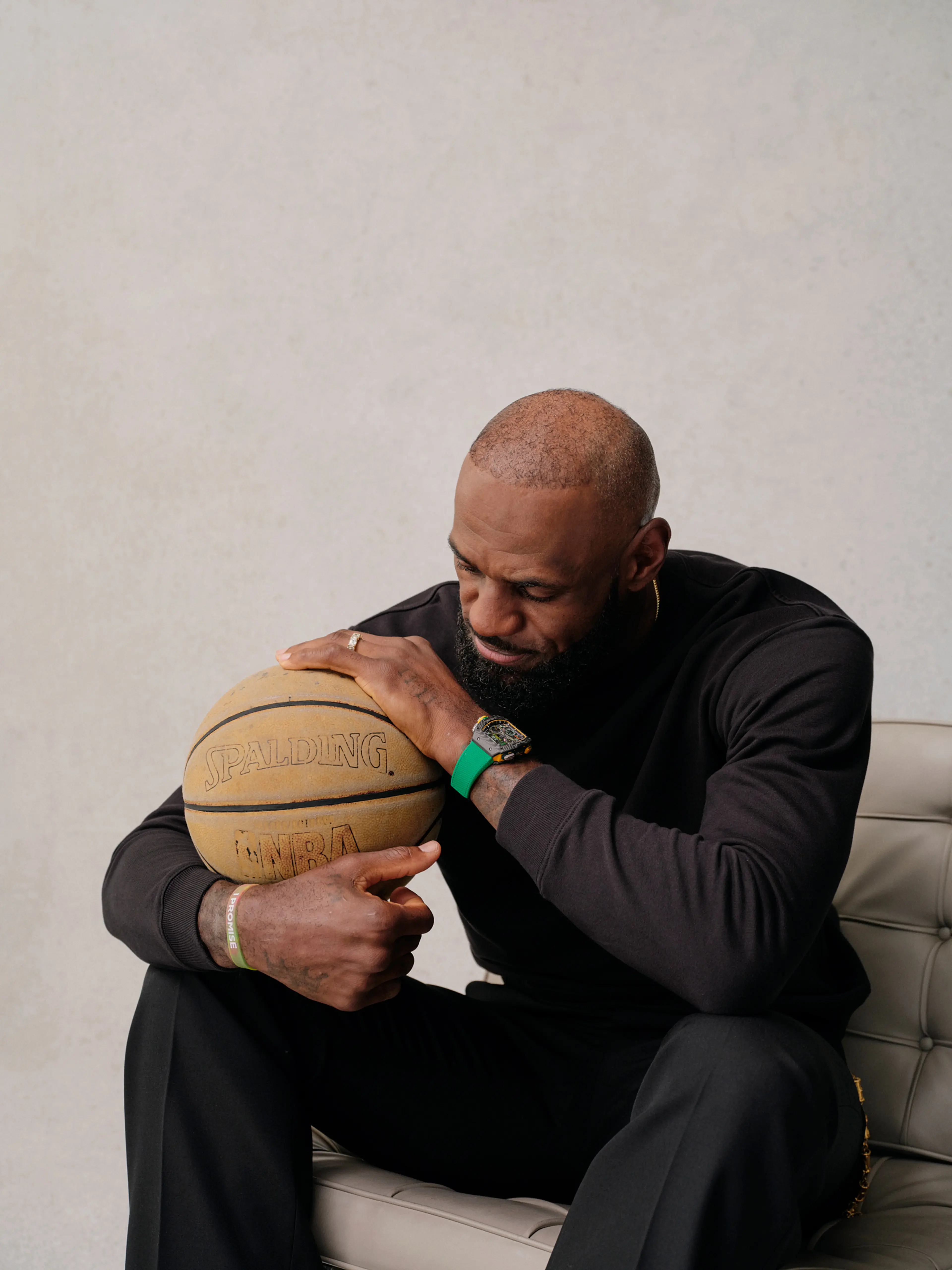
Mark Clennon for TIME
In a 2014 Sports Illustrated article, James announced that after four years in Miami, he’d be returning to the Cavs. “That was, unintentionally, the starting point for a business,” says Carter, who with James in 2015 launched Uninterrupted, a platform for James and other athletes to share their own stories. “I didn’t quite like the fact that, you know, I could sit and talk to the media for 15 to 20 minutes, and then only two minutes of a sound bite will come out,” says James. “I got tired of being interrupted. I got tired of not letting my voice be heard thoroughly and all the way through.”
Uninterrupted’s signature offering The Shop, a talk show in which athletes and celebrities join James and/or members of his inner circle in barber’s chairs, appeared on HBO for four seasons and now runs on YouTube. Credits for his production outfit, SpringHill Company, include documentaries on Ali and the Tulsa race massacre of 1921, the Space Jam sequel, and an Adam Sandler basketball drama. (TIME Studios worked with SpringHill on the docuseries Top Class.) Athletes like Steph Curry, Kevin Durant, Peyton Manning, and Patrick Mahomes have followed James into the media space. “I love storytelling,” James says. He wrote his best script in 2016 when he led the Cavs back from a 3-1 deficit against the record-setting 73-win Golden State Warriors to claim the city’s first title in more than 50 years. James was the unanimous Finals MVP and became the first and still only player in history to lead a championship series in five statistical categories: points, rebounds, assists, steals, and blocks.
TIME100 Sports | 7 Things We Had to Ask LeBron James
That November, Donald Trump was elected President. (James campaigned for Hillary Clinton in Ohio.) As Trump escalated his attacks against athletes who criticized him, James responded in kind. In September 2017, Trump withdrew a White House invite to the Warriors after Curry said he didn’t want to go. In response, James called Trump a “bum” on Twitter. In 2018, James and Durant knocked Trump in a podcast interview, with James saying Trump doesn’t “give a f-ck about the people,” and Durant mentioning that the country is “not ran by a great coach.”
On her Fox News show, Laura Ingraham called James “barely intelligible” and labeled the players’ comments “ignorant.” Then came those flammable four words. “Shut up and dribble,” she said.
Mendelsohn texted him the next day. “Oh, I laughed,” says James. “I was like, ‘Oh man, this white lady is telling this Black man to shut up and dribble. Are you kidding me?’” James didn’t know who Ingraham was. “I definitely don’t watch Fox News,” he says. “You can put that in all caps. I definitely don’t watch Fox News.” He knew her now. “I was like, ‘Ohhh man, she has no idea what she just started,’” he says. “This is about to be the complete opposite.”
James signed with the Lakers in 2018, following his eighth straight trip to the Finals. In his second season with the team, he won his fourth championship, in the 2020 COVID bubble at Walt Disney World; James became the only player in history to win Finals MVP with three different teams. After Derek Chauvin murdered George Floyd in 2020, James founded More Than a Vote, a nonprofit whose registration efforts increased turnout in key areas that Joe Biden needed to win the 2020 election. Later that summer, following the police shooting of Jacob Blake, another Black man, in Kenosha, Wis., NBA players thought about leaving their bubble and canceling the season. James led the charge to stay, contingent on NBA owners making meaningful investment in social-justice initiatives. Efforts by the league, players, and coaches helped sign up 20,000 new poll workers; open 23 NBA arenas and practice facilities for voting; and over the past five-plus years, support legislation that protected voting rights in Minnesota and gave formerly incarcerated people easier access to jobs in New York, Utah, and Pennsylvania.
“She was like one of them schoolteachers, telling you to stop talking in the back and be quiet,” says James of Ingraham. “But she didn’t realize I was the dean. This is my school.”
Peers cite James as an inspiration. Last October Novak Djokovic, the all-time leader in men’s Grand Slam singles titles who turned 39 in May, said James was one of the athletes motivating him to keep going. Olympians Lindsey Vonn, 41, and Allyson Felix, 40, brought him up when discussing their comebacks. Sleep, soft-tissue massages, strength training, yoga, Pilates, cryotherapy, hyperbaric chambers, IVs, and a clean diet have kept James sharp. Some of his longevity stats—he’s played against 36% of all NBA players, he’s the only player to score 40 or more points in a game in both his teens and 40s, he’s played against 10 sets of fathers and sons in the league—often make him chuckle. “It doesn’t make any sense,” he says.
His son Bronny wasn’t born when he made his debut. Now they’re teammates, and the first father-son duo to assist each other on baskets. “Out of all the sh-t I’ve done in basketball,” says James, “that’s the best accomplishment I’ve ever had.”
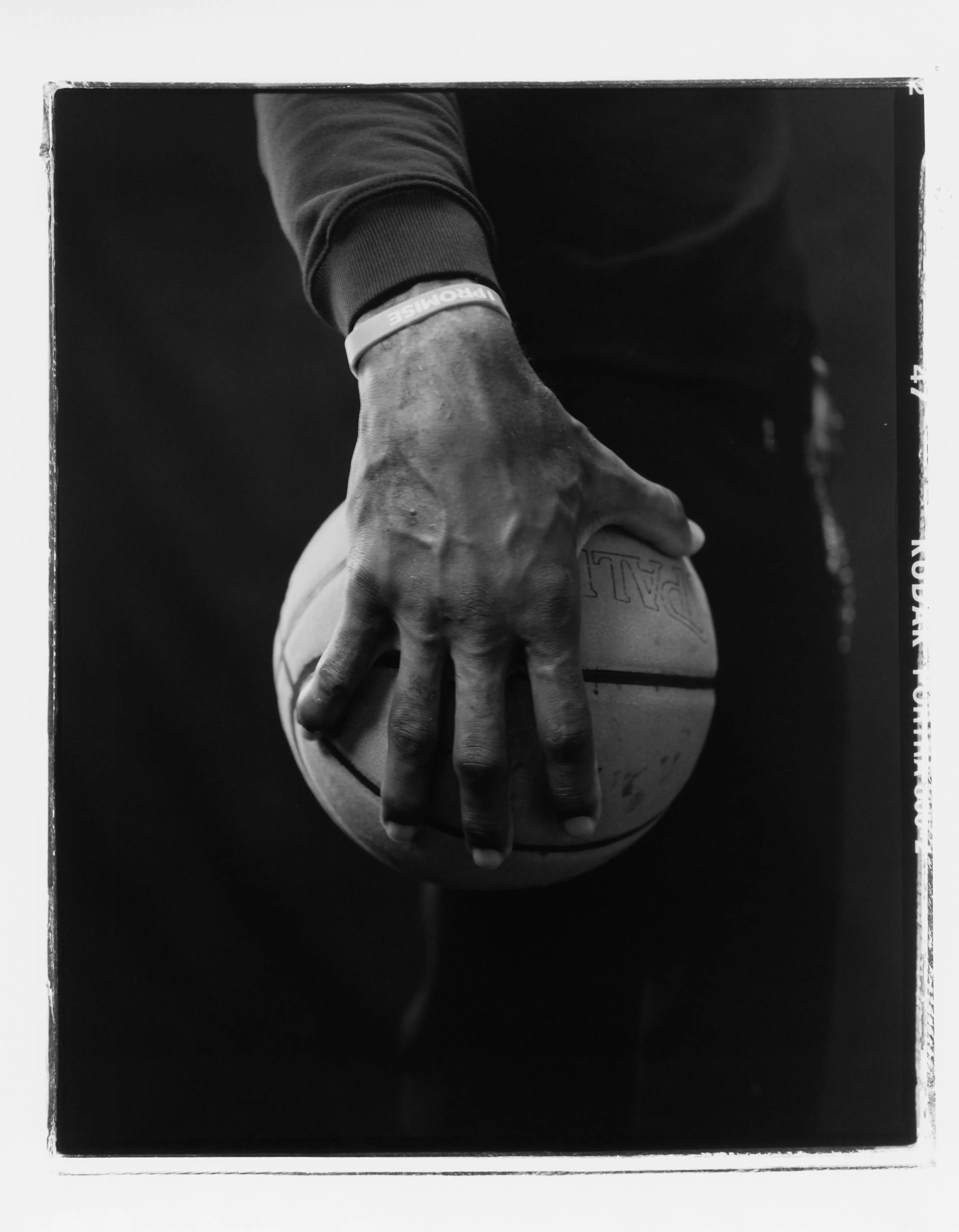
Mark Clennon for TIME
James hears the nepotism claims. “The kid has earned his right to be a professional athlete,” he says. “The thing you’re not going to do is throw stones at us as a family. I’m not letting that sh-t slide, because I know what I’ve created because of what I didn’t have. So if you want to talk about the kid, that he shouldn’t be an NBA player, I don’t care about that. As long as you don’t get to the fatherhood piece. I don’t play those games.”
James appears in no rush to decide on next season. While Bronny remains under contract with the Lakers for at least one more year, his dad is entering free agency. But when asked if he’d take a discount to come back to L.A. and give the team more financial flexibility, James declined to comment. He also suggests that it’s unwise to read too much into his interest in golf—a popular retiree pastime. “I’m happy that I picked it up at this point in my life, but that has nothing to do with my decision on my playing career,” says James. “That is separate. I love golf, man. But I also know the main thing is the main thing. And that’s my love for the game of basketball. If I continue to play, then that’s always gonna be my passion.”
On their podcast, James told Nash his answer may arrive in August. “I love being out there and competing at the highest level, which the postseason is,” James told TIME after the Thunder eliminated the Lakers. “Playing the game that I love and having fun, enjoying the competition, was something that you always live for, no matter where you are in your career.” The lure of family, however, remains. His younger son Bryce, who turns 19 in June, is on the basketball team at Arizona, and his youngest child, daughter Zhuri, plays volleyball.
“I’ve spent a lot of time sacrificing,” says James. “I spent a lot of time putting in the work of my own individual craft, and I’ve had to give up a lot of family time. So a big part of the next 10 years won’t be me getting it back, because you can’t get time back. But my daughter is 11 years old. I’m going to pour into her. I’m going to pour into my wife. Because I wanted to be the greatest that ever played this game, I’ve had to not be the complete husband and complete dad that I want to be.”
Whenever James hangs up his sneakers, he’ll put a bow on an unprecedented journey. “I just knew the police sirens and all that type of sh-t was not for me,” he says. “I knew that the handcuffs was not for me.” And while James won’t directly make the case that he’s the most influential athlete of the past half-century, on the barroom debate about the basketball GOAT, he doesn’t hesitate.
“I’m not taking nobody over me,” says James. “There’s no question. But I think Mike will say the same thing. Rest his soul, Kobe will say the same thing. Magic will say the same thing. Bird will say the same thing. Shaq could say the same thing. The late great Wilt. Kareem. I don’t think none of us are going to take somebody else. If there’s a general manager and he’s eyeballing all of us on a baseline, with the No. 1 pick, it’s gonna be hard not to take me, champ.”
—With reporting by Leslie Dickstein


Commenti
Posta un commento